Friday

Prepping for Next Year Now

It is officially summer break around here! For me that means beginning my Master's degree, moving across town (closer to my school! woo!) and getting everything planned out for next year.

Every summer, I spend hours and hours getting ready for the next year, trying to think of improvements, better listening lessons, smoother transitions, unique ways to keep my students' interest. Allthethings.

My friend Linda over at Floating Down the River has challenged us to come up with a list of things you can do now as school is ending to help the next year go more smoothly. You can link up at the bottom!

Analyze Your Data!

If there's anything that education has taught me over the last 13 years, it is the importance of data. Data can show us what is really going on in our class, what our students are actually learning, and should help us to plan for the future.

During the school year, we are always in a time-crunch, whirl-winding (just made that up) to the end of the year. Shew! Take a minute when the dust settles (but before summer brain kicks in) to evaluate what happened in your class this year.

Student Data

Look over the year's student work. Really dig in to what they missed and why. Was it the kid who was in orchestra three times during that unit, or was it a kid who was there every day and stilled missed it?

Make a tally of the answers for "exit tickets" - was there a pattern? One of my close teacher friends mentioned that her students were having issues with adding the stems to their staff work - bingo! Next year, she will be adding more examples with stems.

Look at the self-assessments - did students feel confident in their understanding or was it more surface level? I find that when students are not confident about their knowledge, many times it is because we had to rush through the preparation phase of learning. Usually when I look back, I see that we were also preparing for a performance, or we ran out of time because of a school holiday. This is a great time to assess exactly how much time you got to spend on each unit.

This is also fantastic data if you are having to speak to a principal or administrator about the number of programs and performances required. When they see actual data regarding the missed curriculum, sometimes that is more persuasive than a tired teacher who just has "too much on her plate."

Teacher Data

Look over your "teacher data" - lesson plans, yearly plans, how many units did you complete? This is a great chance to analyze "what you planned to do" vs. "what you actually did."

For example, every year I make two Yearly Plan documents. The first is the pie-in-the-sky document in August when I have forgotten about assemblies and field trips and orchestra practice and program prep.

The second is usually about halfway through the year, when I come to grips with the fact that the year is half over and I get down and dirty trying to decide what I can cram in with the remaining weeks.

Here is the document I've been using lately. It allows me to do a rough sketch of the year, blocking out any program dates, holidays and events, so I can see the big chunks of time and plan accordingly. I don't want to start a unit the week before spring break (for many reasons!) but I also don't want to finish it the week we get back.
My printed lesson plans have check boxes on them because with over 120 kids rotating through my room each day, it is very simple to check off the items we completed and circle the ones we didn't. Then I can look back on them when planning the next rotation to see if I need to add more time for preparation or more time for practice if I see they are having trouble in the next unit.

Create One Project for Your Classroom

When I think about the list of things I want to do for the next school year, it can get overwhelming! But if I step back and create one thing at a time, it makes it much more manageable. I try to do one creative thing for my classroom early in the summer, before all the activity of summer gets me out of "school-mode."

One year, I ordered banners and stickers from a printing website. Another time I made instrument and manipulative repairs for the next year. I was very thankful I had glued all of the magnets back onto the beat and melody cards come August.

Rest, Relax and Don't Think about School!

Get some R&R time with your friends, family, or a good book! It may seem like a good time to get everything done that didn't happen during the school year - and it is! But make sure you spend time re-charging your batteries and spending time to think about things that are not related to work. Your creative brain will thank you for it!

What do you do during the summer to make your school year better?

Let’s Connect!

Tuesday

Musical Prep in Elementary Music: 2


It's time for part 2 in my Musical Prep series! Don't forget to check out Part 1 here; plus all new: part 3 & part 4!

Let's talk rehearsals!


In my previous post, we discussed planning the schedule of rehearsals (depending on how much time you want to spend) and communicating that with the parents. Now let's get to the nitty gritty - how we ran our rehearsal schedule & what you can accomplish in a limited time.


Our first after school rehearsals were for "character roles" only - students that had auditioned and won "character roles" knew in advance that they would have a few more rehearsals than the other kids.

While we were able to learn most of the blocking during specials class, there were a few scenes that involved a majority of the kids (who may have been in different homeroom classes, some in orchestra practice during specials, etc.). So, we held three blocking rehearsals after school, where we basically finished whatever scenes were left and rehearsed extra scenes as time allowed.

All students were required to have their script & pencil to write down their blocking. Let me give a shout-out to MTI for including a page in every script that teaches students how to write blocking in their scripts! Woot!


Tech Transition Night is specifically for the students who were chosen to do tech jobs during the show. While everyone is invited to (and expected to be at!) Tech Day, some students have been asked to do tech roles during the show.

In our show, these tech roles included: Stage Manager, Assistant Stage Managers (ASMs), Lights, Sound, Wardrobe and Makeup.

Stage Manager provides another set of eyes for the directors. They write everything down in their director's script so that if the teacher directors don't see something, they can mention it. (For example: the #1 mistake in rehearsals was entering or exiting from the wrong part of the stage. Almost every time, the stage manager caught it and would whisper to us "upstage left" or "oops - she's supposed to exit downstage.")

As a stage manager, they have the authority to ask the other students to be quiet, to move to a new spot on stage and to take attendance at the beginning of rehearsals. They are also in charge of following the script and calling out lines if an actor forgets a line, or reading the lines if someone is absent. Stage Managers come to every rehearsal.

ASMs are in charge of moving the set pieces around on stage. They are the only students allowed to touch the set pieces, so it's a huge job that must be filled by reliable students. Tech Transition Night is mostly for ASMs - we assign each set piece/prop to an ASM, and they practice moving from one scene to another over and over!

The Light Operator sits in the "pit" with the directors & Stage Manager and runs the lights. In our shows, we have a simple up-down toggle that controls the lights over the chorus. They follow along their script and write in exactly when they are to have lights up and down.

The Sound Operator also sits in the "pit," directly beside the director. In our experience this year, the adult director (drama teacher) is in charge of the sound board, but the Sound Operator follows along in their script, which is marked with sound cues, and helps with each mic change. They also listen for anything unusual, like a mic that has not been muted (but should!) or if a mic isn't loud enough, etc.

I'll talk about wardrobe & makeup in the next part of the series, when we discuss the Costume Parade. They are the only members of the tech crew who don't have to attend the Tech Transition Night, unless there is a complicated costume change that they need to practice.


We had 2 tech rehearsals (one for each cast) that served as last minute runs for each cast, plus a chance to try out our tech equipment without costumes or makeup. This is supposed to be a full run with mics/sound/lights, with the flexibility to stop and rehearse scenes as needed. All students attend the Tech Rehearsals so that we can see what the show looks and sounds like with all cast, crew & chorus!

One thing that I came to learn is that the unexpected will happen at a tech rehearsal!

During our first series of tech rehearsals (with 5th graders), we didn't have any tech equipment! They morphed into extra blocking rehearsals, and we did sectionals with the chorus.

During our 4th grade tech rehearsals, half of our tech equipment arrived an hour into our first rehearsal and the rest was MIA! Due to things beyond our control, our first cast didn't get to practice with their mics/sound/lights until their first dress rehearsal.

For Blocking & Tech Rehearsals, our students stayed after school. They sat in the back of the gym eating their nut-free snack (brought from home) and took bathroom breaks while the drama teacher and I finished our car rider duty. During this time, our wonderful Americorps worker sat with them and managed bathroom breaks and kept shenanigans to a minimum.

After this, they got a 5-10 minute break in which the ASMs set the stage for the first scene, the students got pencils and scripts, threw away their snack trash and got mentally prepped for rehearsal. Because blocking and tech rehearsals are the shortest of our rehearsals, we did minimum warm-ups, and then jumped into the action.


Dress Rehearsals are a monster of their own! These 4 (2 for each cast) rehearsals were held at the same time as the shows, with the call times & agendas the same as the actual show. For our purposes, we had students arrive an hour and a half before show time.

The student have the first 45 minutes to get into costume & get in line for makeup. It takes almost this entire time, depending on the amount and complexity of makeup.

After getting into wardrobe & makeup, character roles had to report to Mic Check at the front of the stage. Most character roles in our show got wireless mics taped to their faces. Mic Check can get complicated if you have multiple wireless mics - and we had 16!

Side note: The best thing we did was have a trusted "tech guy" come to set up our tech equipment & teach us how to troubleshoot it. Our fabulous volunteer not only set up 16 receivers, taped the mic packs with corresponding numbers and labeled the mic cords - he came back when we were having issues & taught us how to sync different channels when we started having 2 mics come through on one channel! Whew!

It was a beast of a job and, looking back, I will have to think about having someone run our sound for us for the next show!

After Mic Check, all students reported to backstage for warm-up. This helped us to mimic the timeline of a show night, because all students had to be backstage (in our cafeteria, which backs up to the stage) when we open the house to parents 30 minutes prior to the show.

Warm-up gave us a change to get some wiggles out, bond as a team, and of course mentally and vocally prepare for our show!

At "show time" we begin a full run of the show with no stops (ideally). This is very telling of how the show will actually go, and the first time we get a chance to see what it looks like put together.

The directors take notes (with help of the stage manager) during rehearsal and we have a short notes meeting at the end of rehearsal. Everyone should have their script on hand so they can make notes of the things that need fixin'. :-)

After our Notes Meeting we begin a timer - no one leaves until the stage, boys & girls dressing rooms, and both bathrooms are clean & all clothes are hung up correctly. Theoretically, the timer makes the kids move faster & try to beat their time from the night before. When each room is "all clear" then we allow the kids to leave.

Our first dress rehearsal usually takes the longest to clean up before they realize that they need to move faster. Mwahaha. It also depends on how organized the kids are - typically the older 5th graders move faster because they've done it before.

3 Things I've Learned: 

1. Have a plan, stick to the plan, but be flexible for things beyond your control. Prior Planning Prevents Poor Performance!

2. Have reliable parents backstage to help things flow! Can I say that again? Have reliable parents backstage to help things flow! We had some FANTASTIC parents helping with our last show. Their kids were both in the tech crew, so it wasn't imperative for them to be front of the house every show. They each took a turn "going" to the show, sitting in the audience, and it was so much fun to have them building relationships with the kids through rehearsals and shows.

3. Hold the kids accountable to a high standard of performance - and they will achieve it! You have to practice like you're going to perform. Young kids especially cannot practice one way and perform a different way. Whatever you do in practice is what you will do in performance.

Stay tuned for Musical Prep #3 - Tech Day!

Let’s Connect!

Thursday

Musical Prep in Elementary Music: 1


I'm at a new school this year and for the first time ever I have another performing arts teacher on staff with me! Woo! The drama teacher is phenomenal - she and I are doing musicals with 4th & 5th grades this year. We did AristoCats with our 5th graders in February and are just starting 101 Dalmatians with our 4th graders.

There are many things that go into organizing a musical endeavor and I'm going to share a few of the things I've learned this year! This will be a series, so stay tuned for more posts! (Check out part 2 here!)


Before the auditions, there is a ton of work to do! I'm not intending this to be a comprehensive guide, but I do want to hit the highlights of each topic.

Picking a Musical

First, consider the amount of time you are willing to spend in class, plus the amount of time you are allowed to spend outside of class. I didn't want the 16 songs to be the *only* music my students interacted with for the year, so I limited the amount of time to seven weeks.

Because there are two performing arts teachers, we can divide and conquer! First we did several music-only rehearsals in which we combined classes. Then she took the character roles during class time to work on blocking, while I worked with the large group on chorus songs. This allowed us to progress further on the songs while not falling behind on blocking, and ultimately get more done in the seven weeks allotted.

We did not want kids to have to "sit and watch" any longer than absolutely necessary. We had our first "full grade level" rehearsal about ten days before our first performance. After about five weeks of working on songs/blocking separately, we were able to put them together.

Second, evaluate the ability level of your students. Do you have a strong lead? enough students to fill out the major roles? enough boys/girls to fill out gender specific roles?  do you have enough chorus members to do a dance number or would standing on the sides be a better fit?

Third, take the climate of the school into account. You don't want to do a super serious musical for their very first musical experience. In my current school, they have a tradition of performing musicals. We wanted to keep that tradition alive and push it forward by adding tech and incorporating more action for the chorus members.

We chose AristoCats and 101 Dalmatians based on what we thought our students could handle in the amount of time allotted.

Parent Communication

We sent home a large packet of information two months before the performances. In this packet, we included all kinds of information.

"The Packet"
   - Cover Letter with contact information
   - Calendar with every rehearsal & performance date
   - Glossary page (description of each rehearsal & who was required to attend)
   - Student/Parent Contract (including permission to stay after school & permission to publish pictures in the school publications)
   - Student Bio form - for the playbill
   - T-shirt order form
   - Personal Ads order form (Parents can purchase a small space in the program to cheer on their student)
   - Character descriptions & audition information
   - Makeup and costume requirements for chorus members
   - Parent check list* (a timeline of sorts for parents to keep them on track)

*We just added this for the latest program - great response!

Even though we sent home tons of information on paper, we also posted this packet on the drama blog and encouraged every parent to subscribe to our Remind Text.

Character Analysis

Before auditions, I did a quick analysis of the singing solos for each character, so that I had a general idea of the number and type of solos they would be required to do. The drama teacher did a quick tally of the number of lines for each character as well.

There are also character descriptions in the director's manual of our chosen shows, so we looked over the range and type of character that was suggested. (We got our shows from MTI.)


Workshop / Parent Meeting

Two days prior to auditions, we held a workshop in the evening. We invited parents of students that wanted to audition for a character role to meet with the drama teacher while I taught them the audition songs. This is a great time to solicit volunteers for things like backstage help during dress rehearsals & performances, help making costumes, donating makeup and other items for props, etc. After explaining the audition process and answering parent questions (and encouraging them to sign up for the Remind Text!) the parents joined the students in the music room.

After distributing the scenes to memorize, we had a brief question and answer session, followed by a "meet and greet" time. This was a great chance for us to meet some parents (it's both of our first years at our school) and answer tons of questions ahead of time.

Auditions

The auditions themselves were pretty straightforward. I used the students' aural assessment scores from music class as a base line. They earn a score of 3 - match pitch, 2 - almost or 1 - not yet. This gives me a baseline to go back to, in case a student has a case of nerves during an audition, or if there is a tie.

The students had to memorize segments from two of the songs in the show, as well as memorize (and add character to!) one scene. We chose music clips from what was available for them to listen online, for at-home practice.

When they come in for auditions, they stand by themselves in front of the judge table to sing their song (with CD accompaniment track) & perform their scene. Then, we ask them to do a cold read for another character, using the script for a different scene.

And lastly, if we have any questions, we have them do a movement audition. We don't go over this at the workshop, because they have been working on movement and characterization all year in drama specials. We just say, "If you were an army cat, move across the floor like they would," or "Move across the floor like an old country dog." This gives us another level of information about the students' abilities.

Casting / Double Cast

After auditions, we go to a restaurant and spread out all the papers and try to fit all the puzzle pieces together!

We decided to double cast our show for several reasons. We have a large school with around 150 students in each grade level, so we wanted to have plenty of opportunities for students to be involved. We also know (from our specials teammates that have been here many years) that many of the students will be a "no-show" at the performance night. It also was very helpful to have a built-in understudy for each role, in case of illness or other mishap.

We had a few students sign up to perform in "all 4" shows, so those were the only roles that did not get double cast.

This sounds like a ton of work - and it is! But it is worth it in the end when the students put on a spectacular show!

Watch Facebook for the next in the series - rehearsals and Tech Day! <-- Click here for Part 2!

Let’s Connect!
Wednesday

Pinterest Gem: Vocal Warmups for Boys


It's a gorgeous day outside here in Kentucky - and it's only Wednesday, which means I have just a few more days to get everything done. Eek! I'm spending this beautiful sunny day with my pup - she's going to get some well deserved exercise in a bit. But first, I want to share a tremendous find from Pinterest!!

I'm always on the lookout for new vocal warmups to try and I found a gem on Pinterest this morning. Ashley Delaney, a choir director in Denton, Texas, posted a fantastic video with some great vocal warmups. I've used several of these warmups before (and loved them!) but she takes it to another level with her men's choir videos, adapting them perfectly for the boys in choir.

Ashley has collected some great warmups, including belly button "pop-out," face mask on ice (NHL!) and using poison rhythm patterns (with simple body movements) for dynamic breath exercises. Love her!

Here are some of my favorites from her "Where the Wild Things Are" video:

Vocal Tidal Wave with Eyebrow pushups - love this!!


Movement with each warmup


"Down, Set, Hike" A fantastic boy-friendly phrase for working beginning and ending consonants!


Adding a little beat boxing to your warmup!

If you want more great ideas, check out her YouTube channel here.  If you find any more warmup gems, I'd love to hear from you!

Let’s Connect!

Saturday

Tideo Makeover & Singing in Canon

Happy Spring Break! I've been working hard updating products and formatting my resources to make them easier to use in my classroom - and yours!


So What's New? 
First, I'm using a new method for flattening my jpeg images to make each page load faster.

Second, I'm trying to streamline my "look" so that the products have a cohesive feel. *giggle* Really, I just like buying clipart! :-) Hello, my name is Lori and I am a clipart addict.

Check out Tideo's new look! 


Let's talk about Tideo!

I use Tideo in my classroom for practicing sixteenth notes (takadimi) and do pentatonic, after teaching "re."

First, teach the game - it's always a hit!

Here's how I teach the game:
1. Once the song can be sung independently, I have students face the middle of our circle and perform the hand motions for the word, 'Tideo.' (pat-clap-both)
2. Then we "domino" into partners around the circle and practice the hand motions with our partner. (Just pat-clap-both at this point)
3. Next, I have one of the partners form the inside circle, and practice the hand claps a few more times.
<The next week/day>
4. After we are solidly singing and clapping, I have the inside circle take a knee. The outside circle can see each other better this way! I say, "Outside circle, point to the person on your right." After checking that they are correctly pointing around the circle counterclockwise, I say, "Now point at their shoes. That's where your shoes are going to be in just a second when I say 'Go.'"
5. Have students move to the next person in the circle, resume practicing hand clapping pattern on the word 'Tideo.'
6. Repeat steps 4 and 5 until you've sung several times.
7. Somewhere in those repetitions, stop having the inside circle squat down. When they are ready, say, "FREEZE" after the first phrase. Then have students move to the next person. Start singing the second phrase, then call out, "FREEZE!" after the second phrase. Have students move to the next person, start singing on the third phrase, then finish the song.

At this point, I stop the game and have the class watch as I demonstrate what we just did (moving to a new person at the beginning, and after the first and second phrases, on the word, 'Pass.'). Then we try it as a group.

8. When we try it as a group, I call out, "MOVE!" on the word 'Pass,' until they really internalize that we only move on the word pass. Generally my classes get it after that and I just emphasize the word 'pass' while they sing the rest of the song.

My students LOVE this and sometimes we just stop there. But some classes can handle a little more (or by bringing it back the next year, we can add more!).

9. On the 'B' section, have students trade places with their partner on 'Jingle at the Window.' Eventually after a ton of practice, we switch to a wring the dishrag motion for 'Jingle at the Window.'

Shew! That seems like a lot when I write it out!

What do you do to teach Tideo?


For my resource update, I also added new slides for spurring your improvisation practice; my students love coming up with new places and things to pass and new nonsense syllables to say at the end.

This is a great song to do in canon as well. You can do it in huge chunks (Group A start on the A section, Group B start on the B section) or do a true canon, starting after 1, 2 or 4 beats.

When I teach a canon, I always use a song that the students know independently. I have them sing by themselves while I sing in canon. After they identify that I'm singing the same thing as them, but at a different time, I have a small group (2-4 students) come stand by me and sing with me, in canon. After doing this successfully, I break the class into 2 groups and have one group sing the song independently, while the other group sings with me in canon.

Eventually you can have the two groups performing in canon without you while you add a third part to the canon, an ostinato or sing in harmony with them! The possibilities are endless.

I am in love with the new look! Thanks to Melonheadz for the super cute kid clipart.

Let’s Connect!

Three Literacy Ideas for Elementary Music

Teaching music literacy can be a challenge, no matter what school you're in. With simple ideas to facilitate teaching music concepts, you can make music come to life for your students. I'm sharing three ideas that worked well in my elementary music class this week!


Reading Melody
Teaching La with Beach Ball Fun! 

Some of my primary students are learning about "la" this week. I love using the song Bounce High for "la" for the most obvious reason - the word "high" is on the highest pitch. My kids latch onto this song pretty quickly.

We start off by holding imaginary beach balls in our hands and moving them around as a vocal warmup. We transition into the song and move our imaginary beach balls to the melodic contour (middle-high-middle-low) as we sing the lyrics. Check out the process here.

It's GREAT having a ton of beach balls on hand, because you can use them for so many things! I use them for composition, brain breaks, even other songs like Plainsies, Clapsies.

During the presentation lesson (this week), we play Kings and Queens to individually assess who can say the words correctly, use the correct hand-signs and match pitch - all as a solo! Those students who "hit the bullseye" with their voices get their name written on the board in my fanciest handwriting.

Side Note: Kings & Queens is literally the most simple *game* ever! I say, "We're going to play Kings & Queens. Whoever repeats the melody back to me correctly will get their name written on the Kings & Queens list!"

Then I go around the room checking to see if students can correctly echo the melody (with hand signs!), matching pitch and saying the correct syllables. If they get it perfect, their name gets written on the board in my fanciest handwriting. (I write in my swirliest, fanciest print and they love it!)


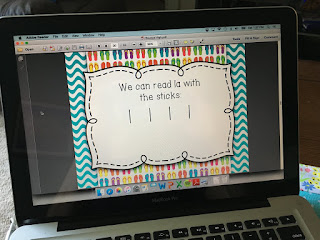
Then we move on to notation -  After reading on the tone ladder, we label the solfege "with the sticks," on rhythm stick notation:


Transforming melodies: After reading this with our hand-signs, I say, "That's tooooo easy! Close your eyes!" And add more so's, mi's and la's. Check it out below:


Listening Lesson
Reading Sixteenth Notes with Rakes of Mallow! 

I love to do Irish songs in the month of March and Rakes of Mallow has been a favorite of mine for many years. It's a simple circle dance that is accessible to many grade levels. Some of my more advanced classes turn it into a double circle dance, just for fun!

Formation: Single Circle, holding hands
Phrase 1: Circle to the right, 16 beats
Phrase 2: Circle to the left, 16 beats
Phrase 3: Drop hands, jump 2x, clap 2x, 4 "baby steps" into the center, 4 "baby steps" back to your spot.
Phrase 4: Repeat phrase 3

After a week of dancing, it's fun to read the rhythms (section A has a simple takadimi pattern; section B has a simple tadimi pattern!) and listen to an arrangement by Leroy Anderson.


Want more ideas? Check out the Rake of Mallow resource in my TpT Shop!


Kindergarten Comparatives
Reading Fast & Slow with Rabbits and Turtles

Kindergarten is getting ready to find out about Fast Beat and Slow Beat, so we have been preparing kinesthetically by moving like rabbits and turtles around the music room.

I start by telling the story of the tortoise and the hare. Then I pull out my rabbit and turtle visuals and we bounce/step in place, depending on which one I hold up. What are these visuals? - a picture of a rabbit and a picture of a turtle!

Next, I use my finger to draw a "laser line" around the movement area - don't go past the laser line or you'll get zapped and have to sit out!

Then we practice (just the boys or just the girls) moving around the room like rabbits while singing a song and I play a drum to keep them on the beat. I say, "Let's move like rabbits!" or "Turtle arms ready!" before we do each one. This solidifies the idea in their brains while they are moving fast or slow with their bodies.


The next week (this past week!) I tell them, "We're going to move like rabbits and turtles again. But this time, I'm not going to tell you which one we're doing, I'm going to play a secret code on my drum and you have to figure out which one we're doing." This helps me assess which ones have it and which ones don't, without too much embarrassment. If they don't do it correctly, they quickly look around at their peers and switch.

Pro Tip: Let's talk about documentation! While they are moving around the room, I am looking for the ones that "get it" and those who are following their friends. I keep a clipboard in my room with a stack of rosters. Each time we do an activity that I want to track, I give each child a score of 3 (got it!), 2 (almost!) or 1 (not yet!).

After that kinesthetic review, I move on to aural questioning (document this too!) - I go straight down my roster and let each kid answer "turtle" or "rabbit" while I play the drum. This should happen very quickly & can be done in one class.

Next week, we will move on to visual prep, where I will do the same thing (play the secret code on the drum) but they will have to hold up their rabbit or turtle card and show me which one they hear. It's a fun time to be in Kindergarten music! :-)

Grab my rabbit and turtle cards in my TpT shop here!

Let’s Connect!


Refresh and Renew

It's Spring Break in my neck of the woods! What are you hoping to accomplish this Spring Break? If Spring Break has come and gone for you, what did you get done? Are you hoping to have some down time?

I love having time to reboot and get ready for the next part of the year. Here are some ideas that I have that I hope will refresh and renew my spirit over the next week!


1. I plan to spend a few hours with my husband and my puppy dog, just relaxing! The first part of the semester was filled to the brim with activity, so a few peaceful moments are very appealing right now. I have a few books in my "to finish" pile (maybe more than a few!) so those will definitely find their place on my schedule.


2. I haven't had a chance to try out my new cookbooks that I got for Christmas! Dashing Dish & the new Pioneer Woman cookbook are on the top of my list for things to try this week! I'm also planning to make a trip to Trader Joe's - my new favorite store.


3. We have eight weeks left of school when we get back, which always seems like a race to the finish. What can we get done before we say goodbye in May? It sounds like a ton of time, but in reality, it's not! With a six day rotation, I see my classes about six to seven times every eight weeks (if I'm lucky!). 

With two rotations of dance curriculum in the mix, we'll have only three or four more classes until our big performance of the year! (eek! that's not a lot of time!!) And since I'm new to Kentucky, I haven't been through a testing cycle, so I'm not sure if I will see all of the classes or not during testing - eek!

In my last rotations of the year, I hope to include a mini version of my "Trip Around the World" with 2nd and 3rd graders, plus as much instrument time as we can! In my experience, all kids are "instrument junkies" - they just love anything to do with instruments. 


4. Make decisions regarding grad school! I am starting my Masters this summer and honestly, I am still undecided about which one to pursue. Online? In person? Music? General Ed? The possibilities are endless and I am still wide open to any of them. 


5. Blog and work on TpT resources! The school year keeps me exceedingly busy, so I'm hoping to use a little time to catch up with some needs in my classroom, plus share what I've been up to! 

Right now, I'm updating older products that need a fresh look, like Tideo
I'm also updating my format - trying to make current resources even better & easier to use for teachers. 


6. We signed a lease and will be moving closer to my school in June. Woohoo! No more huge commute - I could literally walk to school if I needed to. And the best news - it's super close to a Half Price Books. *drool* 

So, it's boxes and packing tape time once again. I need to sit down and organize a to-do list, get some supplies from Target and get going!

What do you have on the calendar for this week? 

Let’s Connect!